Classic Safari Challenge

Classic Safari Challenge
Charging into the Dust by Cabtography

Monday, April 24, 2017

Thursday 20th April, 2017
Kyoto to Nara   (73kms)

A late start into the hills and forests around Nara.

Three Regularities before lunch- narrow rural roads with some traffic and mirrors at blind corners.

Regularity one started at 42kph, down to 34kph and then 32kph. Sounds easy but throw in deep gutters, narrow roads and sharp corners and some traffic and you can soon get behind.

Regularity two was only about 2.6kms in length but had a very tight right hair pin bend. It was a self start at the beginning of a narrow road uphill to the left. A quarry truck was in front of us and we didn’t see the crossed flags starting point as the truck obscured our view and we had to reverse.
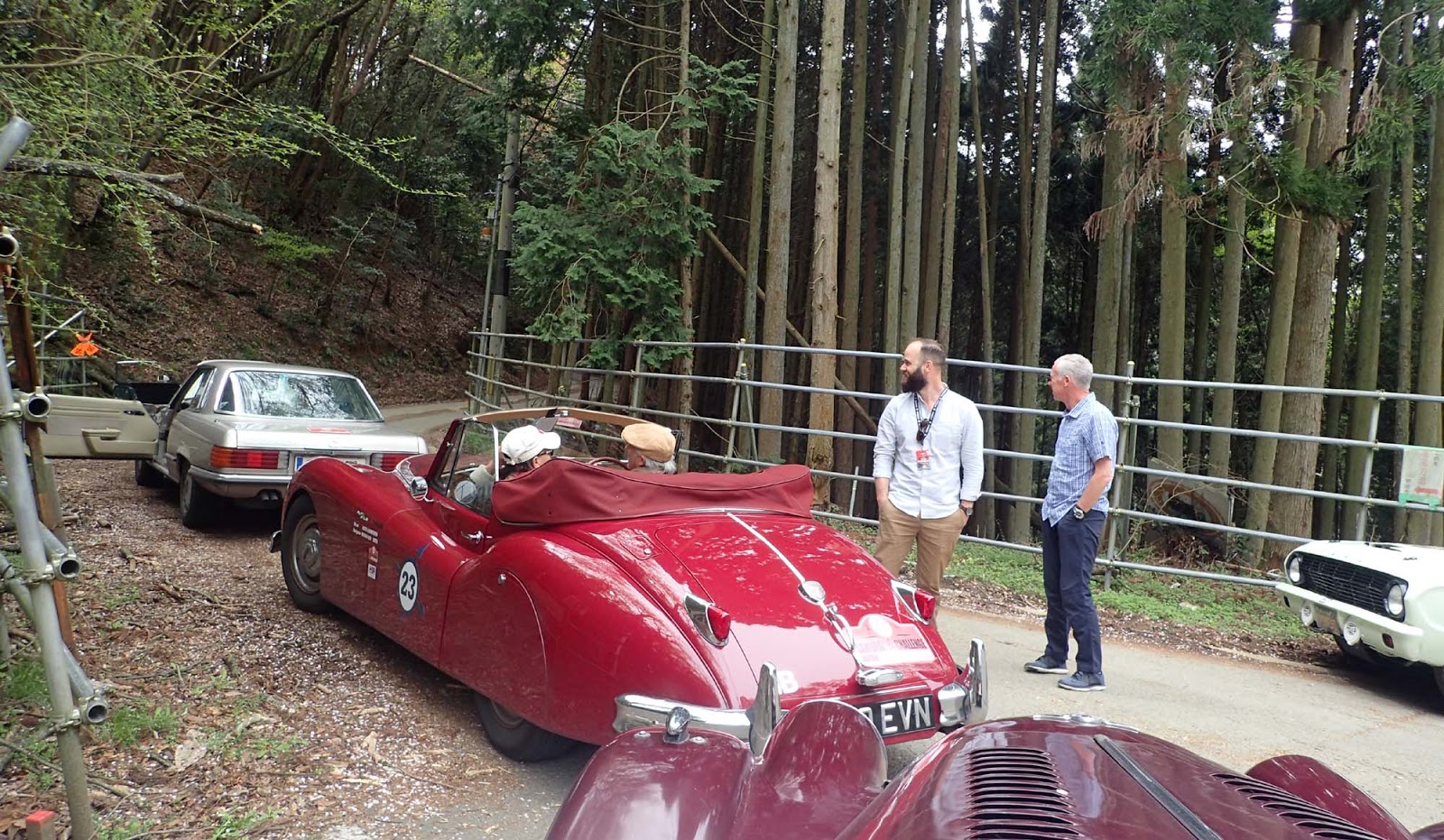

A local car arrived at the same time as us at the hair pin bend and went ahead and we hoped it wouldn’t slow us down as there are few opportunities to pass on these narrow roads. We had to do a three point turn to get around the tight bend.

Just after the finish of this Regularity we came across a large group of locals who were bird watching. They were lined up on the side of the road with their huge professional cameras on tall tripods. The cameras were pointed up the hill so hope we didn’t disturb the birds!

Regularity three started in a road with tea plantations on either side. Average speed was 36kph, down to 34kph then down again to 24kph. The tea plantations here, as you would expect, are so neat and manicured.


Arrived at the hotel in Nara, dropped our bags, parked and then headed by shuttle bus or taxi for lunch at the Museum, in the National Park where all the deer roam about. You can buy Shika Senbei which are special crackers for them.
After lunch we went into the Museum where there was a special exhibition by the Buddhist Master Sculptor Kaikei. Most of the sculptures were wooden and from the 10th to 13th centuries. Exquisite detail on many of them.

We walked back to the hotel via various lanes and happened across some old houses, double story, attached at the lower level with walls of corrugated iron. A real contrast to the modern buildings near them.


A sword demonstration took place during dinner.

Thursday, April 20, 2017

Wednesday 19th April, 2017
Kyoto
Rest Day (for some!)

At 8am Mr Maruta met us at the hotel and we followed him in his little bright yellow Honda out to his workshop about 50 minutes away.


We got to work taking everything out of the car to get to the springs. The springs had sagged so needed to put in some extra leaves which we had brought with us.


Three and a half hours later it was done and we followed Mr Maruta to his friend’s house where Mr Shimizu has five Lotuses, including a 1962 Elite (chassis number 1985). Also in the collection is a Europa, a late model Elan and two Series 1 Lotus Cortinas. His friend was also there and he had a Datsun Fairlady which he drove there from near Mr Fuji. He has twenty-one other cars! The garage was full of memorabilia and Mrs Shimuzu served us lunch.


Tuesday 18th April, 2017
Miyazu to Kyoto  (232 kms)

A fine morning so no need for the bimani.

We drove along the coast and it was interesting to see deserted houses and restaurants. It seems once the nearby motorway went through, many of the fishing villages lost their through trade. Near one fishing port there were a large number of warships and naval vessels, including an aircraft carrier.

The first Regularity, about 50kms from town, was interesting. About 3kms into it we came across a policeman who used his red baton to flag us down. We stopped and he came over to the car. He told us twice that the roads were dangerous and to drive slowly. Just after this incident (apparently he stopped many of the rally cars) we came around a corner and the mechanics’ truck blocked our view of the control as they were parked immediately behind the control car and we thought they were helping a rally car. We didn’t see it until we had passed it. Reversed back quickly!

Next we drove 60kms to the village of Kayabukino-Sato, famous for its thatched roofed houses and traditional crafts. Drove slowly around, took photographs then headed for lunch about 3kms further on.


Parked in the village carpark was a vintage Alfa Romeo, owned by a local, looked to be 1920's and original condition. On its radiator it had a scorpion.


We had a very nice traditional Japanese lunch taking off our shoes as we entered the restaurant and seated ourselves at the low tables. 


The cherry blossoms are falling here and they created a snow like vision as they fell on to the bonnets of cars.


On the way to the next Regularity we spotted a very large racoon. He was on the side of the road and as we approached he ran up the hill. Throughout this trip we have noticed signs on the roads indicating that racoons are about. Many houses have large ceramic or plastic racoons at their front doors.

Regularity two was about eight kms and average speed started at 45kph, then down to 38kph and then up to 40kph.

Regularity three was on narrow roads with overhanging trees, low kerbs, narrow bridges, hair pin bends, moss on all the stone walls and wet leaves on parts of the road. This one was only about 4kms long. Average speed started at 38kph, down to 36kph, then to 34kph. The Armco along this stretch had seen better days, with lots of damaged parts where cars/trucks had failed to take the corners.

Coming into Kyoto we had permission for the cars to park in the inner grounds of the Heian Shrine for a blessing from the priest (for safe travel) and a group photograph. It was the quickest blessing received to date! From the shrine to the hotel the cars drove through the bright orange tori gate.


A special dinner tonight in the Gion district where Geishas (or apprentice maikos) served and entertained us – seated on tatami mats at low tables. Their role was to serve, entertain and converse with us. Several of them entered the Geisha house at the age of sixteen. If they marry, they cannot continue as a geisha.


Monday 17th April 2017
Matsue to Miyazu  (342 kms)

In steady rain we drove along the north coast of mainland Japan.
We had three Regularities before lunch to keep us on our toes.

I forgot to say that yesterday on the way to the first Regularity, going through a small village, we came across an old lady standing in the middle of the road, with hands outstretched as if to stop us and a pram by her side. She was obviously upset about so many cars travelling through “her” backwater village. We stopped and she ranted at us for a while. The pram contained a few vegetables and papers.


The first Regularity today was a climb then descent on deserted narrow roads. Average speed started at 40kph, increased to 48kph then went down to 32kph.


The second Regularity was in Mt Senjozen where there was hard snow on the ground, narrow roads and beautiful treed scenery with an extinct volcano. Average speed started at 48kph, down to 42kph then down to 40kph.


The third Regularity was a bit tricky with navigation as the route went through narrow roads with houses facing on to them. Average speed started at 48kph, down to 36kph, up to 46kph, down to 30kph, up to 47kph and finally down to 40kph.


Lunch was at a restaurant overlooking sand dunes, a protected coastal area. There is a Sand Museum here but we didn’t have time to visit but we did take the chairlift to the dunes. We did not expect to see large sand dunes in Japan.


The Hyogo Prefecture mascot is a yellow phoenix, Habatan, a symbol of hope and rebirth to encourage local people after the earthquake of 1995.

Regularity four was straight forward- follow the main road for 6 kms at 38kph.

As it was still raining it was difficult to enjoy the view but there were some picturesque ports, small islands close to shore including one with a 3km long sand bar. The sand bar is considered to resemble the winding pathway between heaven and earth. Pine trees cover it.

Arrived at the hotel, still raining.

On check-in we were presented with Yukatas to wear to dinner. Dinner was a traditional meal sitting on a tatami mat floor.


Rob & Ellen in a Jaguar XK140 DHC came in well after dinner had started.
Their fuel pump had stopped working in the middle of a long tunnel, my worst nightmare. A rally car behind them stopped and tried to get assistance. The police came after about 15 minutes and they were towed out of the tunnel. These tunnels can be either single or double laned, very noisy and fast speed. 

Wednesday, April 19, 2017

Sunday 16th April 2017
Hiroshima to Matsue (298 kms)

This morning buses took us to the Hiroshima Atomic Bomb Dome and Peace Park. Hiroshima was declared a City of Peace in 1949. The Park has memorials to those who lost their lives on 6th August 1945 and also to those who later succumbed to diseases as a result. The Memorial Museum has poignant exhibits of the belongings of many young students who were caught in the inferno- the clothes they were wearing, shoes and documents. Many of these were discovered by parents and families as they went searching for their loved ones.

We placed the paper cranes made on the boat yesterday in the area set aside for them, near the memorial to the young girl who was two years old when the bomb struck and twelve when she died of the effects of radiation.


We then drove north through the Chugoku mountains to the Prefecture of Shimane which faces the Sea of Japan. The mascot of this area is Shimanekko (neko means cat). The mascot wears a hat in the shape of the roof of the Taisha shrine.

Lunch was in the fish market in Hamada. Lots of locals were out to look at the cars. There was also a display of Caterhams, and Lotus 7 modern equivalents. The fresh fish was delicious.


Only one Regularity today through narrow twisting roads. Average speed started at 44kph then went down to 30kph.


We then drove through Iwami Ginzan, a World Heritage Site and old mining village with traditional houses and shops. We drove on to the Heritage Centre which has a silver mine museum. The mine produced fine quality silver for 400 years and it is believed that a third of the world’s silver was produced here in the sixteenth century.

Next was the Izumo Taisha shrine, one of Japan’s most important shrines, not generally open to tourists. We received another blessing here.


On the way to the hotel we drove around the grounds of the Matsue Castle (one of few original castles in Japan) which has survived earthquakes, floods and fires.

At dinner were privileged to have an Iwami Kagura performance. To the loud beat of large drums, four large dragons/snakes danced around to the story of daughters being taken away by them. Hard to describe but it was colourful energetic and fascinating.
Saturday 15th April 2017
Kokura to Hiroshima  (246 kms)

This morning we left behind Kyushu, the most southern island, and travelled over the large suspension bridge to Honshu. Only one Regularity today and we had to drive 148kms, mostly by Expressway, to get to the starting point.

This Regularity was interesting for the change in speeds over a short distance. Starting at 42kph, changing down to 35kph then 32kph. There was confusion at the start as there were two marshalls at the designated start point who said the actual start was “further on” and to follow the roadbook. Several cars turned back after about 3kms thinking they missed a self-start. Turning back was an achievement in itself as the road was narrow with overgrown sections. The area also had quarries and gravel trucks. The truck drivers were very polite and waited patiently for the rally cars to move on.

At lunchtime we arrived at Iwacuni for a visit to the beautiful 5-arched bridge. We were here six days ago and the cherry blossoms are now falling and green leaves appearing. 
On our arrival there were men dressed as samurais, welcoming us to the bridge.


For lunch we sat on our haunches and ate from Bento boxes- bits of fish, omelette, pickled vegetables etc.


We had to be at the hotel by 3pm as we were going out for a dinner cruise to the island of Miyajima, famous for the tori gate built on tidal sands and the orange structure forms the iconic image of Miyajima. Unfortunately it was raining but the boat supplied umbrellas and we were able to walk to the tori. People throw coins up to the cross beams for good luck or wedge them in the lower columns. Deer also wander about and they are considered messengers of the gods.


On the boat we had an origami lesson and made paper cranes to deposit in the Peace Park tomorrow as symbols of peace and hope.


Saturday, April 15, 2017

Friday 14th April 2017
Day 3   Aso to Kokura (198kms)

Free time until midday. We drove up to the volcano area but were warned that the road could be closed due to wind direction or gases. The museum was closed and the road further on also was closed, Good view from the narrow twisting road, despite more roadworks.  Some viewpoints allowed a dramatic view across the expansive caldera and the grasslands.


Lots of horses with very thick coats in the paddocks as well as cows grazing on the lush grass. Apparently the milk from these cows is rich and creamy. Japan has a law prohibiting the importation of milk – but the feed for the cows is imported.


AT 10.30 we had to be at the Kurokawa Nursery School which has only been open for one year due to the old one damaged by the 2016 earthquake. Cherry trees were donated for the perimeter of the building and our job was to finish off the planting by shovelling dirt around the bases with the help of the very young children. Lots of young children in very colourful outfits and very obedient.


Next was a circuit test at the Autopolis Circuit – four times around the lengthy circuit and then off as you passed Point A on the fifth lap. Then it was on to a carpark within the complex where A to F cones were in place and we had to drive around the cones in the correct order and from the correct angle. The bogey time was 40 seconds. We did it in 1.06.

Lunch was at the circuit restaurant where we were given T-shirts. Finally onto a Regularity which we stuffed up as there was an interim control and we thought it was the finishing point.

Then it was 120kms to the north coast through rural towns, tree covered hills (with logging industry), a large reservoir, small cultivated fields, many bridges and a few tunnels.


During dinner we have five local ladies in kimonos giving us a demonstration of how to fit the obi/sash to the kimono. It is a work of art and I would need an extra two hours in the morning to get dressed.